
The short version
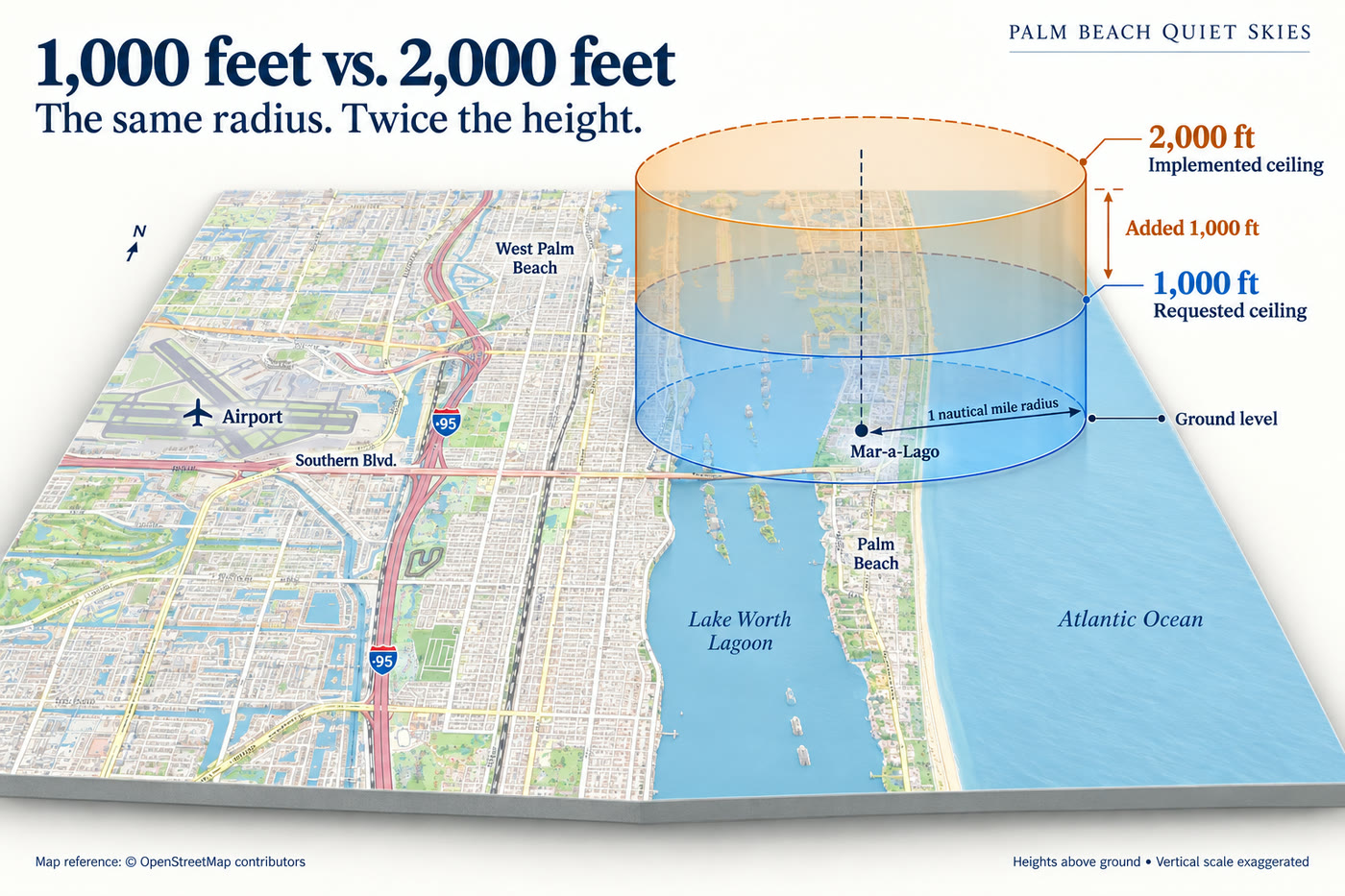
The Secret Service asked for a restricted area up to 1,000 feet over Mar-a-Lago, the same as it asked for over Trump Tower in New York.1 New York got 1,000 feet. Palm Beach got 2,000.2
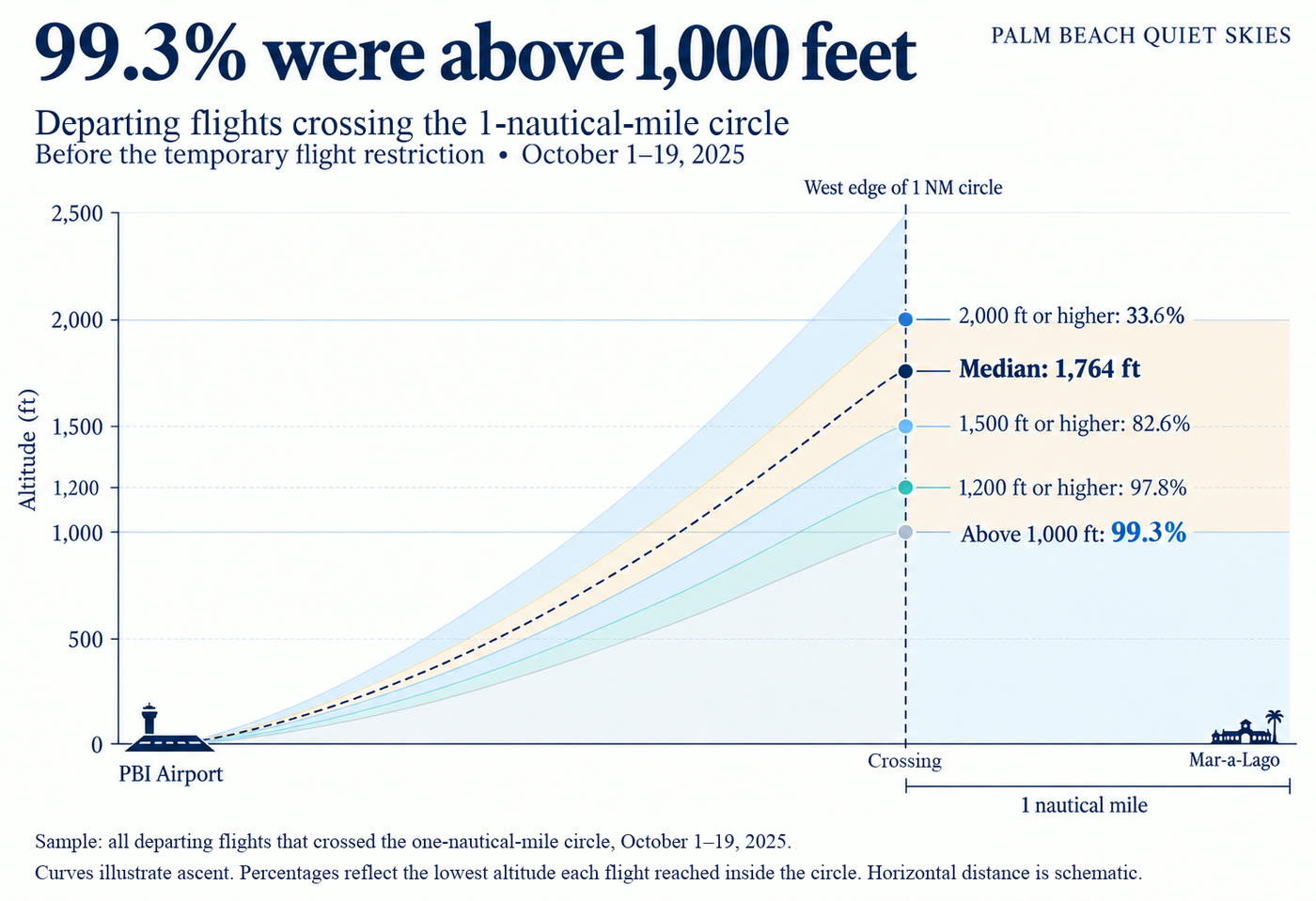
The FAA gives two reasons for the extra 1,000 feet. It has not yet published the analysis behind either, and we would like to see it.3 Its second reason is that flights in the area were all below 1,000 feet anyway. Flight records from the 19 days before the restriction show the opposite: 99.3% of departures were above 1,000 feet.4
At the ceiling the Secret Service asked for, those departures could fly their old routes again, if the FAA restored the old procedures, which a lower ceiling would allow. Departures are about three-quarters of the flights that now pass through the restricted area.5
We are asking the FAA to set the ceiling at the 1,000 feet the Secret Service originally requested.
For the record
Everything below is the detail behind the short version above: the FAA’s own words, the comparison, the counts, what the analysis does not cover, and how it was done.
What the proposal says
The FAA’s explanation is one paragraph in Section III of the proposed rule:
Although the September 16, 2025 letter from USSS requested 1,000 feet AGL as the ceiling, USSS and FAA agreed to a 2,000 feet AGL altitude ceiling. A ceiling of 2,000 feet AGL would allow more time to respond to any threats in the area. In addition, FAA determined that setting the ceiling of the SSI flight restriction at 2,000 feet AGL as opposed to 1,000 feet AGL would not impact any additional operations. Any flights previously in that one NM area would have been under 1,000 feet AGL on approach to or departure from DJT.
“AGL” means above ground level; the “SSI flight restriction” is the temporary restriction in place since October 20, 2025; “USSS” is the Secret Service, “DJT” the airport’s code, and “NM” a nautical mile. The proposed permanent rule keeps the same one-nautical-mile radius and states the ceiling as 2,000 feet above sea level, which the FAA says is about 20 feet lower, at approximately 1,980 feet above the ground.
What the Secret Service asked for, and what New York got
One letter, dated September 16, 2025, covered both residences. It asked for the same thing at each:
| Secret Service request | New York (Trump Tower) | Palm Beach (Mar-a-Lago) | |
|---|---|---|---|
| Radius | 1 nautical mile | 1 nautical mile, with a flat edge along the East River | 1 nautical mile |
| Ceiling | Surface to 1,000 feet | Surface to 1,000 feet | Surface to 2,000 feet |
| Status today | — | Permanent rule, effective October 29, 2026 | Temporary restriction; permanent rule proposed |
The two temporary restrictions were issued in the same minute on October 18, 2025, one at the requested 1,000 feet and one at double it. In New York the FAA also shaped the restricted area to protect the helicopter routes along the East River, so it does tailor these areas to the aviation activity around them.
The proposal says the Secret Service and the FAA “agreed to a 2,000 feet AGL altitude ceiling.” That sentence is all the proposal discloses on the point: it cites no document recording the agreement and no analysis supporting it. The only Secret Service request in the docket asks for 1,000 feet. In court, the FAA has since said that “the FAA’s own data showed” the higher ceiling “would not materially increase the number of affected operations,” citing two items in its administrative record for the altitude decision and the negotiation.6 Neither is in the rulemaking docket. We are asking that they be placed there, so that the public can comment on them.
Two differences are worth stating plainly, because they are real. New York has no major airport two miles away, and the FAA says Palm Beach needs a Special Flight Rules Area rather than a prohibited area so that the main runway stays usable. The FAA does not give either as its reason for the higher ceiling; its two stated reasons are examined below.
The first reason: “more time to respond”
We support the protective mission and do not claim to know what it requires. A permanent rule owes the public an explanation that can be read and answered; this one does not yet include it. The reasonable request: publish the supporting analysis, with a non-sensitive explanation of the security rationale, withholding only what protective security requires.
In court, the Secret Service has given reasons the proposal does not: that drones could watch the property whether or not he is there, that switching a restriction on and off would cause confusion, and that the closed airspace gives time and distance to assess any aircraft that enters it.7 Those are reasons the public should be able to read and answer in the rulemaking itself. None of them says why the ceiling must be 2,000 feet rather than the 1,000 the Secret Service asked for.
The second reason: “would not impact any additional operations”
The proposal cites no flight data for this statement and does not say which flights the FAA looked at. Its court brief puts the same point more narrowly, saying the higher ceiling would not “materially” increase the number of affected operations; the proposal itself says it “would not impact any additional operations.”6 Because the statement is about flights “previously” in the area, we examined the days before the restriction took effect: every day from October 1 through October 19, 2025. (Starting October 20, 2025, traffic was routed differently.)
What the flight records show
| October 1–19, 2025 | Result |
|---|---|
| Days examined | 19 (every day that month before the restriction began on October 20) |
| Flights that crossed the one-nautical-mile circle | 2,192, of which 2,182 were departures (the other 10 arrivals or other flights); 2,181 departures had usable altitude data and are the base for every percentage in this table |
| Stayed above 1,000 feet throughout the reconstructed crossing | 2,166 (99.3%; 99.4% with the altimeter adjustment) |
| Lowest point inside the circle at or above 1,200 feet | 2,133 (97.8%) |
| Lowest point inside the circle at or above 1,500 feet | 1,801 (82.6%) |
| Lowest point inside the circle between 1,000 and 2,000 feet | 1,433 (66%, about two out of three) |
| Never below 2,000 feet inside the circle | 733 (33.6%, about one out of three) |
| Median lowest altitude inside the circle | 1,764 feet |
The 15 departures that reached 1,000 feet or lower inside the circle were five small piston aircraft, six business aircraft, one helicopter, two flights with the callsign TEDDY bound for Joint Base Andrews, and one airline departure at about 990 feet.
In plain terms: before the restriction, the band between 1,000 and 2,000 feet is where most departures were at their lowest as they crossed the circle. That does not match the statement that flights previously in the area would have been under 1,000 feet. On its own, it does not show which routes would change under a different ceiling, because authorized flights can still pass through the restricted area. We would like to understand how the records and the statement fit together, and we would be glad to share our own records and method with the FAA to help.
What this analysis does not cover
- Arrivals. FlightAware’s archive would not return October 2025 arrival records for 18 of the 19 days, so this analysis covers departures. Arrivals cross the circle only when the airport operates toward the west, and they cross it low: our 2026 flight records show arriving flights crossing the circle almost always below 1,000 feet. For those flights the FAA’s description largely fits. In our 2026 records, departures make up about three-quarters of the flights crossing the circle below 2,000 feet.
- Altitude. Altitudes are those recorded for each aircraft from its transponder, in 100-foot steps. We have not confirmed whether FlightAware’s archive adjusts them for local air pressure. The result is about two out of three either way: 65.7% as recorded, and 65.5% after an approximate adjustment using the airport’s nearest hourly altimeter reading. Neither figure is a precise measurement of height above the ground; the airport itself sits about 20 feet above sea level.
- Overflights. Only flights arriving at or departing from the airport were counted, which matches the FAA’s own wording (“on approach to or departure from DJT”).
How we measured it
We analyzed the archived FlightAware records available for flights to and from the airport on October 1–19, 2025. Departure listings were available for all 19 days; arrival listings were not available for 18 of them, and a few flights lacked usable tracks or altitudes. Flights were classified as departures from the origin airport in each flight record.
A flight counted as crossing the circle if its track entered a circle of one nautical mile around the center point the FAA uses (26°40′37″N, 80°02′16″W). Between reported positions we assumed straight-line movement only when the reports were no more than two minutes apart, so no crossing was created by drawing a line across a long gap in the data. For each crossing we recorded the lowest reported or reconstructed altitude inside the circle.
The analysis was run twice, with separately written programs. Both found the same 2,192 flights crossing the circle, with identical counts on every one of the 19 days. The two runs classified a handful of flights differently. The figures on this page and in the chart come from the second run, which is fully reproducible. The data and method will be filed in the FAA’s docket before the comment period closes; until then we will share them with the FAA, researchers and reporters on request: write to info@palmbeachquietskies.org, or media@palmbeachquietskies.org for press enquiries.
What a 1,000-foot ceiling would change, in detail
At the ceiling the Secret Service requested, departures that stayed above 1,000 feet throughout the crossing (99.3% of them) could have flown their historic routes without entering a 1,000-foot restricted area. Restoring the historic procedures would be a separate FAA decision; a 1,000-foot ceiling would make it possible. In our February–July 2026 records, of the flights crossing the circle below 2,000 feet, about three-quarters are departures and about one-fifth are arrivals. The ceiling question therefore concerns the larger share of today’s traffic; it does not by itself determine which routes the FAA would restore.
It would not fix everything. Arrivals cross the circle low, because that is where an approach path is: about 98% of them are below 1,000 feet, so a lower ceiling does not release them. Arrivals cross the circle mainly when the airport is operating toward the west, and air traffic control already routes them through on those days. Those flights need a different remedy: changes to how arrivals are routed or authorized on the days the airport operates toward the west, which a lower ceiling alone does not provide.
What we are asking the FAA to do
Set the ceiling at the 1,000 feet the Secret Service originally requested, the ceiling it received in New York; and place in the docket the analysis the FAA told the court it has (AR 159–60 and AR 557), withholding only what security requires, so the public can answer it.6
The full list of what to ask for is on Take Action. Whether the proposal should have had a written environmental review is a separate question, with its own page.
Every legal characterization on this site is our reading as residents; every quotation and figure is sourced. Where the FAA’s reading differs, we will publish the correction.
Footnotes
-
Secret Service letter of September 16, 2025, docket item FAA-2026-10827-0003: one nautical mile, surface to 1,000 feet above the ground, at both residences. ↩
-
Both temporary restrictions were issued at 14:54 UTC on October 18, 2025: NOTAM FDC 5/2811 (Trump Tower, 1,000 feet, with a flat edge along the East River) and NOTAM FDC 5/2809 (Mar-a-Lago, 2,000 feet). New York’s became permanent at 1,000 feet as Prohibited Area P-75, 91 Fed. Reg. 48255 (July 31, 2026), effective October 29, 2026. The proposed Palm Beach rule states its ceiling as 2,000 feet above sea level, about 1,980 feet above the ground. ↩
-
FAA, “Establishment of Special Air Traffic Rules in the Vicinity of President Donald J. Trump International Airport (DJT),” 91 Fed. Reg. 56380 (Sept. 2, 2026), docket FAA-2026-10827, Section III: “USSS and FAA agreed to a 2,000 feet AGL altitude ceiling. A ceiling of 2,000 feet AGL would allow more time to respond to any threats in the area. In addition, FAA determined that setting the ceiling … at 2,000 feet AGL as opposed to 1,000 feet AGL would not impact any additional operations. Any flights previously in that one NM area would have been under 1,000 feet AGL on approach to or departure from DJT.” The paragraph is written about the temporary restriction, whose ceiling the permanent rule carries forward. No document is cited for the agreement and no analysis for either reason. Full paragraph and the two real differences between the sites are under “For the record” above. ↩
-
Coalition analysis of FlightAware records for October 1–19, 2025, every day that month before the restriction took effect: of 2,181 departures that crossed the circle with usable altitude data, 99.3% stayed above 1,000 feet throughout the crossing, and 1,433 (65.7%, about two out of three) were between 1,000 and 2,000 feet at their lowest point inside it. Flight records: FlightAware historical flight data; altimeter readings: the airport’s automated weather station via the Iowa Environmental Mesonet archive. Arrivals are not covered, for the reason given under “For the record” above, where the counts, caveats and method are. ↩
-
FAA brief in Palm Beach County v. FAA, D.C. Cir. Nos. 25-1282 et al., filed August 11, 2026, printed pp. 25–26: “Although the Secret Service requested a restriction at 1,000 feet, the FAA imposed it at 2,000 feet, concluding that the higher altitude provided materially better response time without materially increasing the number of affected operations. AR 159-60.” And: “The 2,000-foot ceiling was selected specifically because the FAA’s own data showed it would not materially increase the number of affected operations beyond what a 1,000-foot restriction would have caused. AR 159-60.” The brief describes the process as a “negotiation” with the Secret Service (AR 557). “AR” is the administrative record filed in that court case; those pages are not in the rulemaking docket. ↩ ↩2 ↩3
-
Declaration of Matthew C. Quinn, Deputy Director, U.S. Secret Service, executed July 30, 2026, filed with the FAA’s brief in Palm Beach County v. FAA, D.C. Cir. Nos. 25-1282 et al. (brief, pp. 89–91 of the PDF): the threat “must be mitigated to the extent possible whether he is in residence or not” (¶11); drones “offer adversaries the opportunity to conduct unauthorized surveillance, whether the President is in his residence or not” (¶14); “Going back to an ‘on-and-off’ airspace closure posture … may unnecessarily create confusion and compromise security” (¶15); the restrictions provide “critical awareness … for threats posed by manned aircraft, including commercial flights, by affording time and distance to better assess the intent of and appropriately respond to any commercial airline that breaks the security threshold” (¶14). The declaration was made in litigation over the temporary restriction; it is not part of the proposed rule or its docket. ↩